How to Plan Off Grid Power for Your Property
14 October 2026 | By RJ Hill Electrical
A successful off-grid system is not defined by how many solar panels fit on the roof. It is defined by whether your property can keep working through a dark winter week, when demand is high and solar generation is low. Learning how to plan off grid power starts with an honest view of how you use electricity, then matching the system to the site, the seasons and the level of independence you need.
For some properties, full off-grid living is the right answer: perhaps there is no practical mains connection, or the connection cost is prohibitive. For others, a grid-connected solar and battery system delivers most of the financial and resilience benefits without the cost and compromise of disconnecting entirely. The right route depends on your energy use, location and priorities.
How to plan off grid power: measure demand first
The starting point is an energy audit. Do not base a system design on a monthly electricity bill alone. Bills show total consumption, but an off-grid system must also cope with when you use power and the highest load required at any one time.
List every electrical appliance and identify its wattage, daily running time and whether it is used all year. Pay particular attention to higher-demand equipment such as electric showers, ovens, hobs, kettles, immersion heaters, heat pumps, workshop machinery and EV chargers. These loads can rapidly increase the size and cost of the inverter, battery and generation equipment.
A small fridge may use relatively little energy over a day, while a 3 kW kettle uses substantial power for only a few minutes. Both matter. The fridge influences battery capacity; the kettle influences inverter capacity. This distinction is often missed when people attempt to size a system from annual consumption alone.
It is also worth separating essential circuits from discretionary use. Lighting, refrigeration, broadband, alarms, selected sockets and heating controls may need uninterrupted supply. An electric vehicle charger, tumble dryer or workshop equipment may be acceptable only when the battery is full and solar production is strong. Designing around priorities can make an off-grid scheme more affordable without making the property feel restrictive.
Reduce consumption before adding generation
Every kilowatt-hour you avoid using is a kilowatt-hour you do not need to generate, store or back up. Energy efficiency is therefore a core part of off-grid planning, not a separate project.
Replace inefficient lighting, review old refrigeration, improve insulation and draught-proofing, and consider whether water and space heating can be supplied more efficiently. In many UK properties, moving away from direct electric heating or electric hot-water heating has a bigger effect on off-grid viability than adding another panel to the roof.
This is not an argument against electricity. A well-designed heat pump, for example, can be a sensible part of an energy strategy, but it must be considered carefully because winter heating demand coincides with the lowest solar output. The more efficiently the building retains heat, the more practical the system becomes.
Size solar for the worst useful season
Solar PV will normally be the main generation source for an off-grid property. In the UK, however, production varies considerably through the year. A system that produces surplus energy in June may generate only a fraction of that amount in December.
This seasonal difference is the central challenge. If you size solar only for average annual generation, you may have plenty of unused summer power but not enough energy during extended periods of cloud, short days and higher winter demand. A dependable design looks at expected generation month by month, with particular attention to late autumn and winter.
Roof orientation, pitch, shading and available area all affect the outcome. South-facing arrays often provide the highest annual yield, but east-west layouts can offer a broader generation profile across the day. Ground-mounted solar may suit rural sites with sufficient space and limited roof capacity. It can also make maintenance and future expansion easier, although planning considerations, cable runs and ground conditions need to be assessed.
Shading requires a proper survey. A chimney, neighbouring tree or roof feature can affect output disproportionately, especially where shade falls across multiple modules. A professional design should model the site rather than rely on broad assumptions.
Choose battery storage for usable autonomy
Battery storage bridges the gap between generation and demand. It stores excess solar power for the evening, overnight and periods of low production. The key question is not simply, “How large a battery can I buy?” It is, “How long must essential loads run without meaningful generation?”
A battery sized for one night of normal use may be suitable where a generator is available as a fallback. A remote property that must operate through several poor-weather days needs significantly greater usable capacity, along with enough solar or alternative generation to recover the battery afterwards.
Battery specifications need careful interpretation. Nominal capacity is not always the same as usable capacity, and the maximum continuous discharge rate must support the property’s expected load. Battery chemistry, warranty terms, installation location, ventilation requirements and future expandability should all be considered. A battery system should also be installed where it can be safely isolated, inspected and maintained.
For many households, it is practical to create an essential-loads consumer unit. This keeps critical circuits powered during an outage or low-energy period while preventing non-essential equipment from draining the system. It is a more controlled approach than trying to power every circuit indefinitely.
Plan a realistic backup source
Even a generously sized solar and battery system can face prolonged winter weather with very limited generation. A backup generator is often the sensible answer for fully off-grid homes, farms and businesses. It should not be viewed as a design failure. It is an insurance policy against poor weather, unexpected demand and maintenance periods.
The generator must be correctly sized and integrated. An undersized unit may struggle with starting currents; an oversized one can operate inefficiently at light load. Automatic generator start can protect battery reserves, while manual operation may be sufficient for a lower-cost system where someone is regularly on site.
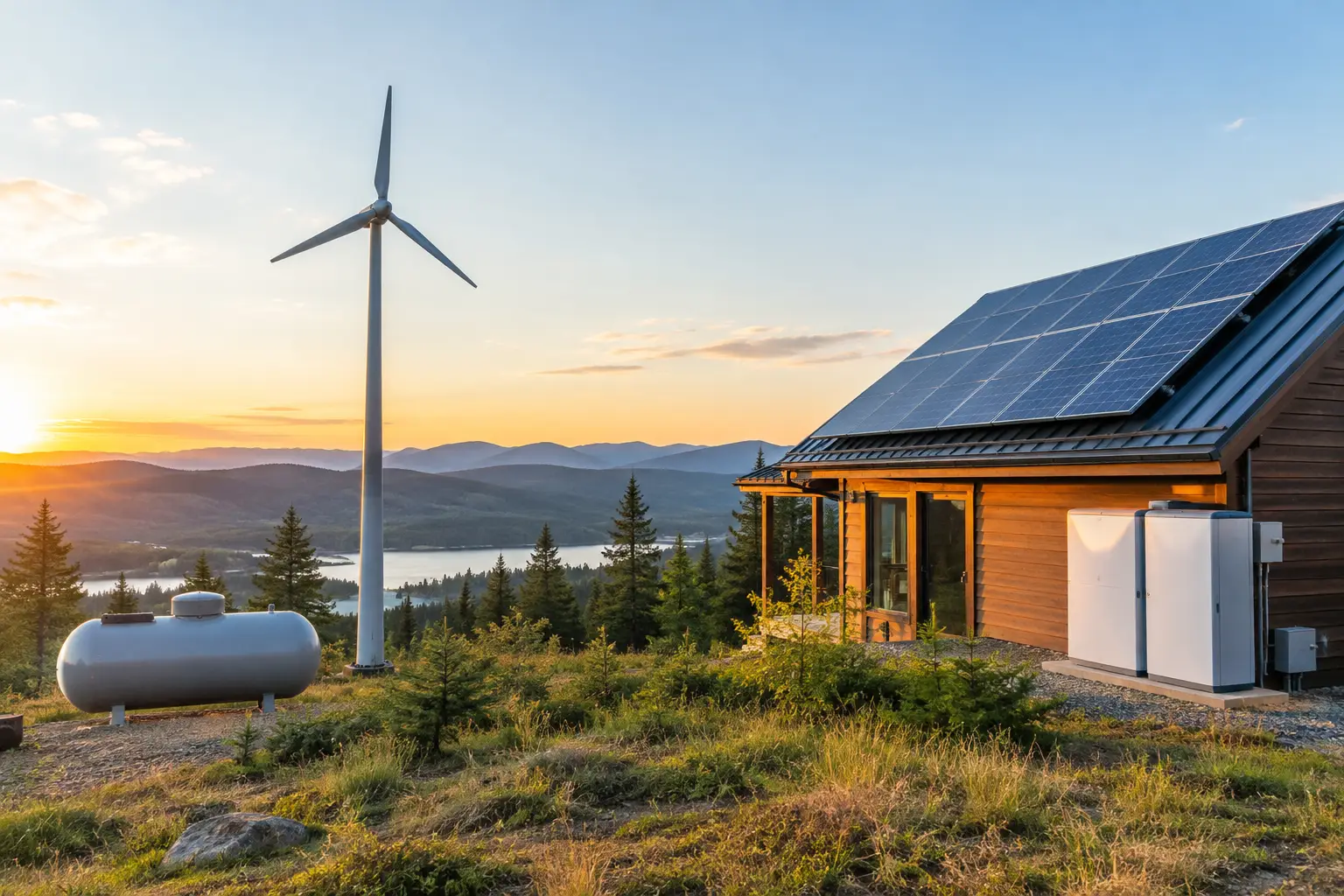
Some properties can also use wind, hydro or another generation source, but these are site-specific technologies. Wind needs a genuinely suitable, exposed location rather than occasional gusts. Hydro can be highly consistent where water rights, flow and site conditions allow. Solar remains the most widely applicable option, but a mixed generation approach can improve winter resilience in the right setting.
Consider the electrical design, not just the equipment
An off-grid installation requires more than panels and batteries. The inverter must supply the required peak load, manage charging safely and provide a stable electrical supply. Cable sizing, earthing, surge protection, isolation, distribution boards and protective devices all need to be designed correctly.
This is particularly important in older properties, agricultural buildings and sites with multiple outbuildings. Long cable runs can introduce voltage drop, and existing wiring may not be suitable for the new arrangement. If there is a mains supply that will remain available, the changeover between grid, battery and backup generation must be planned so that systems operate safely and as intended.
A qualified electrical installer can assess the existing installation and build a solution around it rather than forcing a standard package into an unsuitable property. RJ Hill Electrical combines more than 20 years of electrical experience with renewable energy system design, helping property owners establish what is technically practical before work begins.
Check permissions, standards and future needs
Solar installations can often be installed under permitted development rules, but this depends on the property, mounting method, listed status and location. Ground-mounted arrays, conservation areas and larger commercial schemes may need additional checks. If the property remains connected to the network, the Distribution Network Operator may also need to be notified or approve aspects of the installation.
Plan for change as well. A growing family, home office, electric vehicle, conversion of an outbuilding or new workshop can alter energy demand quickly. Where budgets allow, choosing scalable battery storage, allowing roof or ground space for extra solar, and installing suitable containment for future cables can avoid expensive disruption later.
The best off-grid plans are based on measured demand, realistic winter performance and clear priorities for what must stay powered. Start with a site survey and a detailed energy assessment, then build a system that gives your property dependable power rather than an optimistic headline figure.