UK Plug In Solar: Is It Safe for Your Home?
5 September 2026 | By RJ Hill Electrical
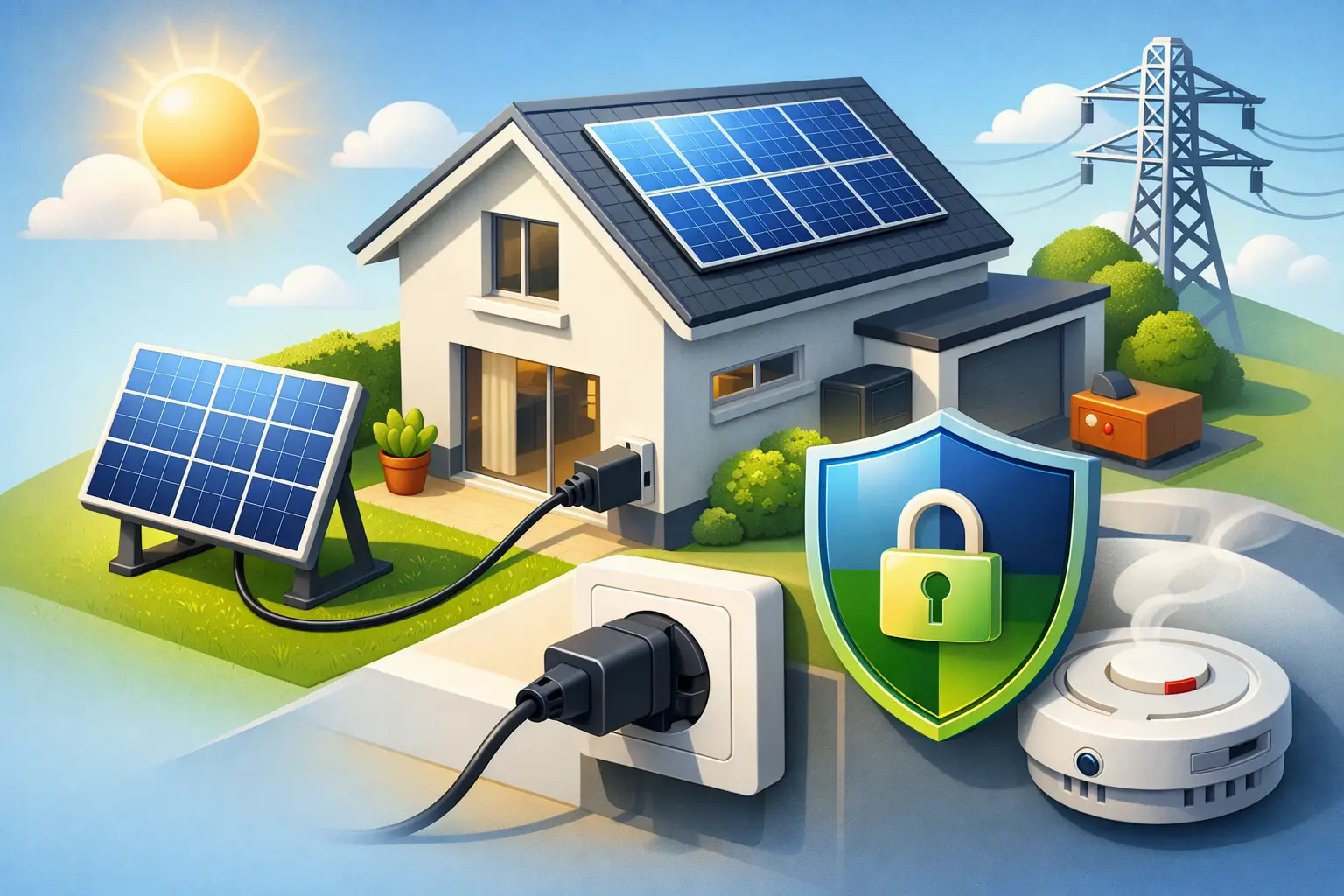
A small panel on a shed roof or balcony can look like an easy answer to high electricity bills. That is the appeal of UK plug-in solar: buy a panel and microinverter, plug it in and let it reduce the electricity your home draws from the grid. In practice, however, connecting any generation equipment to a UK electrical installation needs more thought than the marketing often suggests.
A plug-in kit may have a place for a very limited number of properties, but it is not a substitute for a properly designed solar PV system. Before buying one, homeowners need to understand how it interacts with their wiring, their Distribution Network Operator (DNO), and their household energy use.
What is UK plug in solar?
Plug-in solar, sometimes called balcony solar or plug-and-play solar, normally consists of one or two solar panels connected to a small microinverter. The inverter changes the panels' DC electricity into 230V AC electricity for use in the property. Rather than being hard-wired into the consumer unit, some products are marketed as connecting through a standard plug socket.
When the sun is shining, the generated power is used first by appliances already running in the home. A fridge, broadband router, television on standby or washing machine may use some or all of that output. If generation exceeds what the property is using at that moment, power can flow back towards the grid.
The principle is straightforward, but the output is small. A typical kit might generate a few hundred watts under good conditions. It can help cover background daytime demand, but it will not power an entire home, charge an EV reliably, or provide meaningful resilience during a power cut.
Is plug-in solar safe in the UK?
Safety depends on the equipment, the circuit it is connected to and the condition of the installation. A standard socket circuit was designed primarily to supply power out to appliances. Adding generation onto that circuit can change how current flows through cables, connections and protective devices.
This is why a simple claim that a kit is safe because it has a UK plug is not enough. The inverter must be suitable for UK grid connection and have the required anti-islanding protection. Anti-islanding means it shuts down if the grid fails, preventing electricity being fed onto a network that engineers may be working to repair.
The existing electrical installation also needs assessment. Circuit loading, earthing arrangements, RCD protection, cable condition and the consumer unit all matter. A poor connection, an overloaded circuit or unsuitable equipment can create avoidable risk. Extension leads, multi-way adaptors and improvised outdoor connections are not appropriate for solar generation equipment.
A professionally installed system is generally hard-wired on a dedicated arrangement, with correct isolation, labelling and protection. It is designed around the property rather than added to the nearest available socket.
The DNO still needs to be considered
Connecting a solar inverter means connecting generation to the public electricity network, even if the system is small. This brings DNO requirements into the picture. Small compliant systems may fall under the G98 process, where notification is commonly made after installation, while larger or non-standard arrangements may need approval before work starts.
The exact route depends on the inverter rating, the property supply and other generation already installed. For example, a home with an existing rooftop PV array and battery may have little or no remaining export capacity for additional generation. A competent installer can establish what is permitted and manage the required notification or application.
What savings can you realistically expect?
Plug-in solar only saves money when its electricity is used as it is generated. That makes the household's daytime base load more important than the panel's headline wattage.
If a 400W kit is generating strongly at midday but the property is using only 100W, much of the potential output may be exported with little or no financial return. Conversely, a household with always-on equipment, refrigeration, home working or regular daytime appliance use may consume a greater share directly.
Weather, orientation and shading have a significant effect too. A south-facing, unshaded mounting position will usually perform better than a vertical north-facing wall or a roof affected by trees and neighbouring buildings. Winter output is also far lower than summer output, precisely when many households are thinking most about energy costs.
For this reason, plug-in solar can reduce a modest portion of daytime electricity use, but savings should be approached conservatively. It is best viewed as a small reduction in imported electricity, not a route to a zero-bill home.
When a fixed solar PV system makes better sense
For most homeowners and businesses, a roof-mounted solar PV system delivers better value because it can be designed to match real consumption. Panel numbers, orientation, inverter capacity and battery storage can all be selected around the building's needs.
A larger professionally installed system can support more of a property's electricity demand, including daytime appliances, heat pumps and EV charging. Where suitable, battery storage can retain surplus solar electricity for use in the evening, improving self-consumption and reducing grid imports after sunset.
It also creates a clearer foundation for future upgrades. A customer may start with solar panels, then add a battery when tariffs change or install an EV charger as their transport needs evolve. Planning the electrical infrastructure properly from the outset avoids duplicated work and helps each part of the system operate together.
MCS-accredited installation is particularly valuable where customers want an established route for compliance, documentation and potential export arrangements. The right system is not necessarily the biggest one. It is the one that provides a sensible return while being safe, compliant and suited to how the building actually uses power.
Questions to ask before buying a plug-in solar kit
Before committing to a plug-in product, ask the supplier whether the inverter is approved for UK grid operation and whether the installation method complies with current UK electrical requirements. Ask how DNO notification will be handled, what happens during a grid outage, and whether the product is intended for use on a standard domestic socket circuit.
You should also check the proposed mounting position. Panels need secure fixings that can withstand wind loading, and they must not create a hazard to people below. Leasehold properties, flats and listed buildings may have additional permissions or restrictions. A balcony rail that appears convenient may not be structurally suitable for a panel and mounting frame.
Finally, consider your objective. If the aim is simply to offset a small, steady daytime load in a suitable property, a small system may be worth investigating after an electrical assessment. If the aim is substantial bill reduction, battery storage, EV charging or greater energy independence, a designed solar PV installation will usually be the more effective investment.
Choose a system designed around your property
Solar should make a property cheaper to run without creating electrical uncertainty. At RJ Hill Electrical, we assess the roof space, electrical installation, energy use and future plans before recommending solar PV, battery storage or related upgrades. That practical approach is particularly useful for customers across Lincolnshire, Norfolk, Cambridgeshire, Rutland and Leicestershire who want a system built for long-term performance.
A small plug-in panel may sound like the quickest route to solar, but the best decision starts with the right question: how much electricity do you want to offset, and what will your property need over the next decade? A professional assessment gives you an answer based on your home or business, not a promise printed on a box.