Tethered vs Untethered EV Charger Compared
13 July 2026 | By RJ Hill Electrical
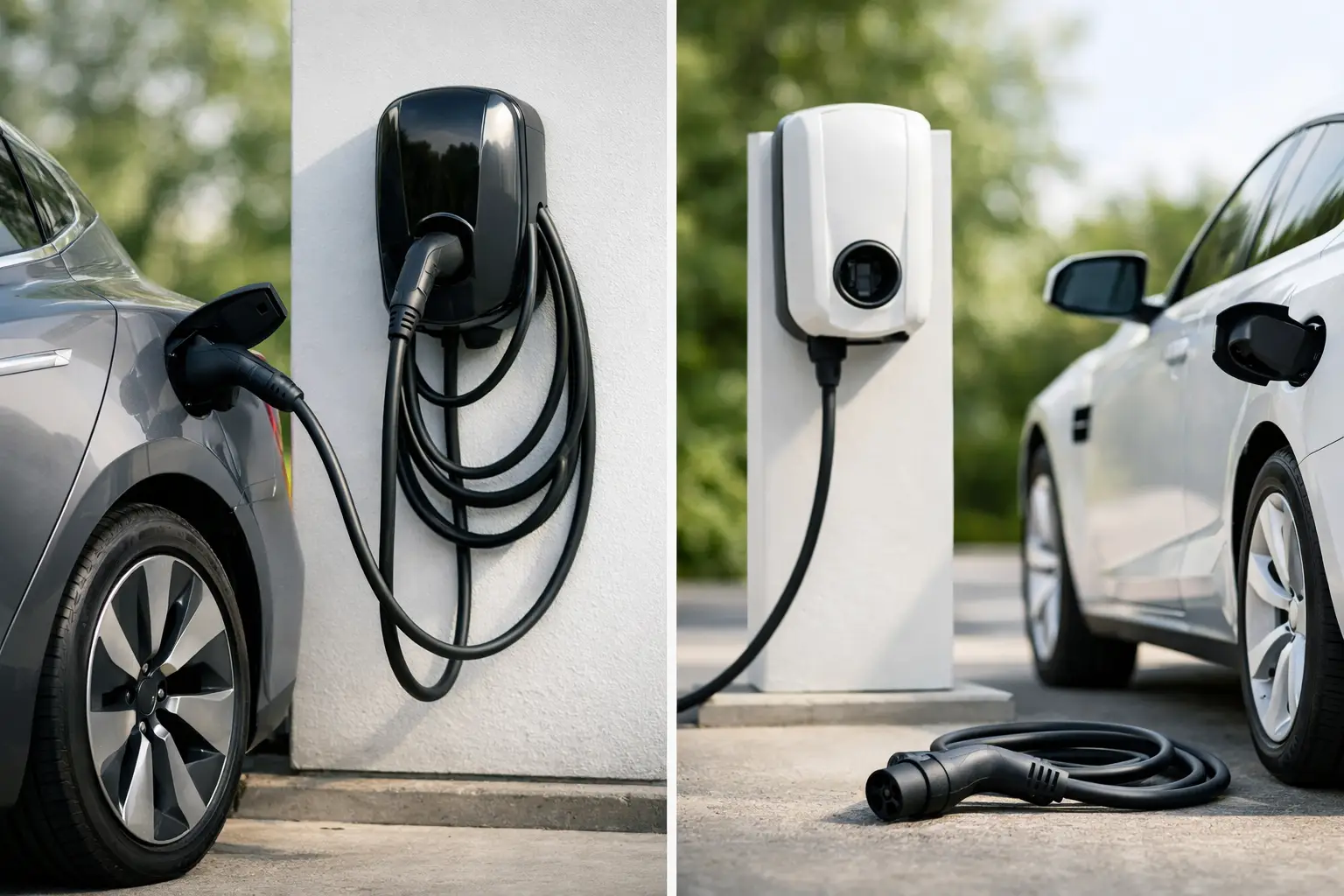
A tethered vs untethered EV charger decision often comes down to one everyday detail: do you want the charging cable ready and waiting on the wall, or would you rather use the cable stored in your vehicle? Both can charge an electric car safely and effectively when correctly installed. The better choice depends on how you use the property, the vehicles you own and whether you want to integrate charging with solar PV or battery storage.
For most homeowners, the question is less about charging speed and more about convenience, appearance and future flexibility. For businesses, it can also affect how easily staff, visitors or fleet drivers can use the charge point.
What is a tethered EV charger?
A tethered charger has a charging cable permanently attached to the unit. At the end is typically a Type 2 connector, which is the standard connection for most modern electric vehicles in the UK. You park, unwrap the cable and plug it into the car.
The cable is normally stored on a holster or neatly wound around the charger when not in use. Because it is always in place, there is no need to take a cable from the boot before every charge.
This is the most straightforward option for a household with one electric vehicle, particularly where the driveway layout makes charging part of a regular routine. Arrive home, plug in and let the charger do the rest according to your schedule or electricity tariff.
The main benefits of a tethered charger
The biggest advantage is convenience. A fixed cable is useful on dark, wet evenings, when the last thing you want is to search through the boot for a charging lead. It also reduces the chance of leaving the cable at another location after using a public charge point.
A tethered unit can look tidy when it is installed in the right position, with enough cable length to reach the vehicle without trailing across a walkway. It is also a sensible choice where drivers may find a simple plug-in routine easier, such as at a family home with several regular users.
For a business with company vehicles that return to fixed bays each evening, tethered chargers can make charging more consistent. Drivers do not need to rely on a cable being available in each vehicle, which can help keep a fleet ready for the next working day.
Points to consider before choosing tethered
A tethered charger is less flexible if you change to a vehicle with a different connector type. Type 2 is widely used across UK and European EVs, so this is unlikely to affect most drivers, but it is worth considering if you own or plan to buy a vehicle that needs a different connection arrangement.
The cable is also exposed to the weather and everyday handling. Quality units are designed for outdoor use, but the lead should be treated carefully and stored properly. If it becomes damaged, replacement can be more involved than simply replacing a separate vehicle cable.
Cable length matters too. A five-metre lead may be ideal for a charger mounted close to the vehicle charging port, while a longer lead may be needed if cars park in different positions. A site survey helps prevent the common mistake of fitting a charger that only comfortably reaches one parking arrangement.
What is an untethered EV charger?
An untethered EV charger, sometimes called a socketed charger, has a socket on the front rather than a permanently attached lead. You use your own Type 2 charging cable, connecting one end to the charger and the other to the vehicle.
The charge point itself is often more compact and discreet when not in use. Once charging is complete, the cable can be unplugged and stored in the car, garage or property.
The main benefits of an untethered charger
Flexibility is the main reason to choose an untethered unit. If different cars use the same charger, each driver can use the cable that suits their vehicle. This can be particularly useful at workplaces, rental properties and homes where vehicle ownership may change over time.
An untethered charger can also be a good choice where visual appearance is a priority. With no fixed cable on the wall, the installation can look cleaner, especially on the front of a property or near a customer-facing business entrance.
For commercial locations, socketed units can limit the risk of a cable being left on the ground, damaged or used unnecessarily. Drivers bring their own lead, as they often would when charging at many public locations.
Points to consider before choosing untethered
The trade-off is that you need to carry and handle the cable. That may only take a minute, but it is a difference you will notice if you charge frequently. The cable also needs a dry, sensible storage place after use, rather than being left on the driveway.
It is worth having a good-quality charging cable of the right current rating and length. A cable that is too short can restrict where you park, while an unnecessarily long, heavy cable is less convenient to manage. Avoid relying on extension leads or improvised arrangements for EV charging.
At a workplace, untethered chargers work best where drivers are used to bringing their own cables. If the aim is to make charging as easy as possible for staff or visitors, a tethered charger may be the more user-friendly option.
Tethered vs untethered EV charger: the practical comparison
Neither charger type is inherently faster. Charging speed is determined by the charger’s power rating, your vehicle’s onboard charging capability, the electrical supply and any smart charging settings. A 7kW tethered charger and a 7kW untethered charger will generally deliver the same charging performance under the same conditions.
The choice is therefore about how the system fits your routine. Tethered is usually the practical winner for a single-car household that charges at home several times a week. Untethered often suits properties where flexibility, a cable-free appearance or multiple vehicle types are more important.
Security should be considered in either case. Many modern units include cable locking while charging, app control and other access features. The best approach depends on whether the charger is behind a gate, on an open driveway or installed at a shared commercial site.
Weather and cleaning are also worth thinking about. A fixed cable is convenient, but it will need occasional wiping down and sensible storage. A removable cable can stay inside the vehicle, but that means it may be wet or muddy when you put it back in the boot. These are small details, yet they often determine long-term satisfaction with the installation.
Solar charging and off-peak tariffs
The charger format does not decide whether you can charge from solar or use cheaper overnight electricity. What matters is choosing a compatible smart charge point and designing it properly around the wider electrical system.
A smart EV charger can be set to charge when electricity is cheaper, helping reduce the cost of running an EV. Where solar PV is installed, compatible systems can also use surplus solar generation to charge the vehicle. This can be especially valuable during daylight hours when the car is at home or at a business premises.
If you have, or are considering, solar panels and battery storage, look at the whole system rather than buying a charger in isolation. The charger should work with your available supply capacity, energy tariff, typical driving mileage and household or business demand. In some cases, load management is needed to prevent EV charging from placing unnecessary demand on the incoming supply at busy times.
Installation quality matters more than the cable type
Whether a charger is tethered or untethered, it must be installed to suit the property and current electrical requirements. The location needs to be practical for parking, protected from avoidable impact and positioned so the cable does not create a trip hazard or cross a public pavement.
The installer should assess the consumer unit, earthing arrangement, cable route and supply capacity before recommending a solution. They should also consider smart functionality, future solar integration and whether another EV may be added later. A cheaper charger in the wrong location can quickly become an expensive compromise.
RJ Hill Electrical designs EV charging installations around how customers actually use their homes and businesses, including solar PV, battery storage and plans for future energy use. With more than 20 years of electrical experience, the focus is on a safe, practical installation that supports lower running costs rather than a one-size-fits-all recommendation.
Which charger should you choose?
Choose a tethered charger if you value the quickest everyday routine, usually charge the same vehicle at home and want the cable ready to use. It is often the most convenient solution for a private driveway.
Choose an untethered charger if you want a tidier-looking unit, expect several vehicle types to use it or prefer the flexibility of changing cables in future. It can be particularly well suited to shared and commercial settings.
The right charger is the one that fits your parking arrangement, vehicle, tariff and wider energy plans. A well-positioned, professionally installed unit will make charging easier every day and can help turn lower-cost electricity or surplus solar generation into useful miles.