Power Cut Backup Options for Homes and Businesses
23 August 2026 | By RJ Hill Electrical
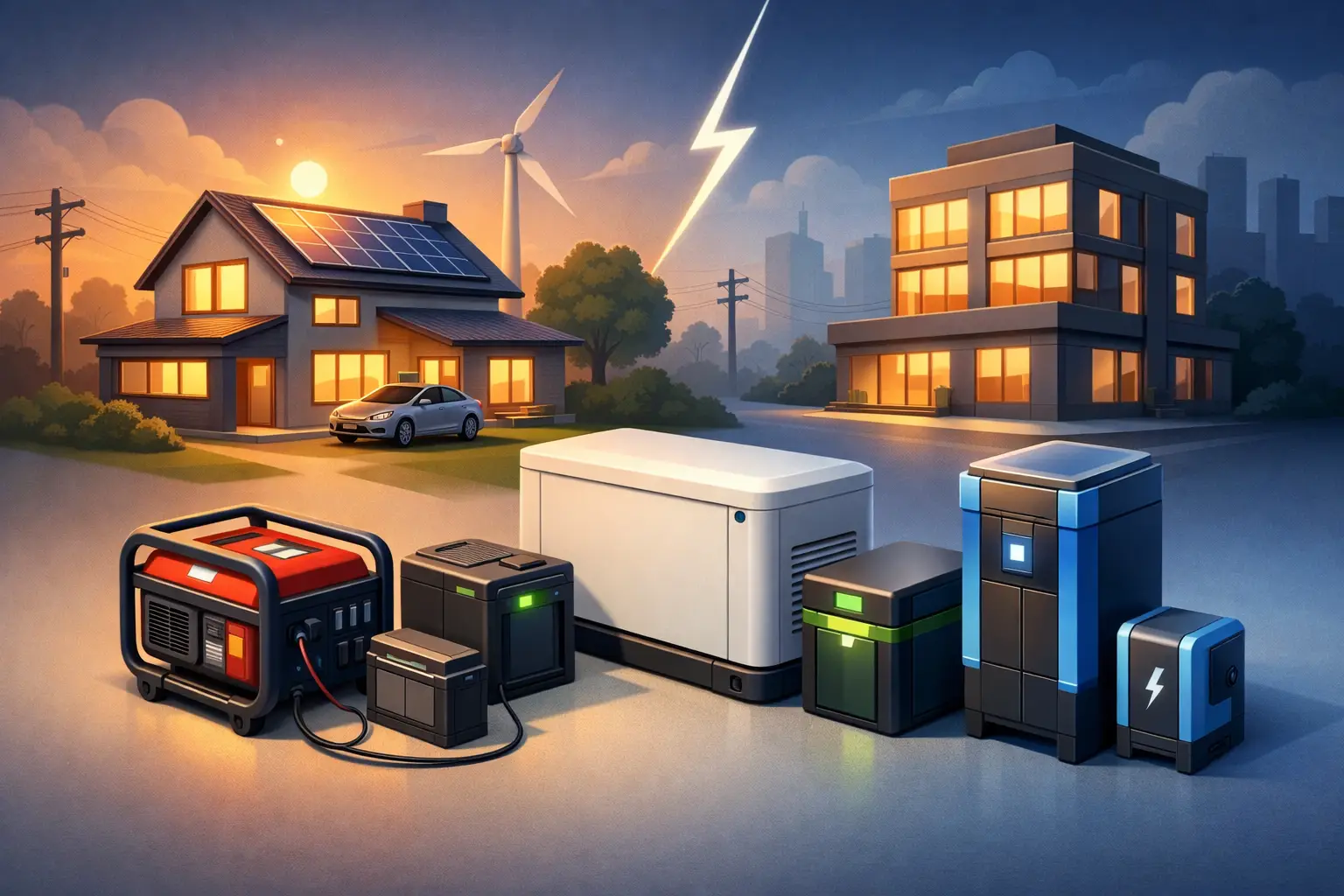
A power cut is more than an inconvenience when your heating controls, refrigeration, internet connection or business equipment rely on electricity. The right power cut backup options can keep essential circuits running safely, but the best answer depends on what you need to protect, how long outages typically last and whether you also want to reduce everyday energy bills.
For many UK properties, battery storage is now the most practical starting point. It can store lower-cost electricity or surplus solar generation for later use, while providing backup power when the grid fails. However, not every battery installation automatically works during a power cut. The system needs the correct backup capability, wiring design and changeover equipment from the outset.
What needs to stay on during a power cut?
Start with the outcome, not the equipment. A whole-property backup system sounds attractive, but it can be expensive and may not be necessary. Heating, selected lighting, your broadband router, fridge-freezer, alarms and phone charging are often the priority for a home. A business may need to maintain tills, IT equipment, refrigeration, security systems, emergency lighting or a small number of critical production loads.
Make a realistic list of the circuits that matter. This allows an installer to calculate the likely demand and specify a battery or generator that will perform when you need it. It also avoids a common problem: fitting a backup supply that works well for lights and Wi-Fi, then expecting it to run an electric shower, immersion heater, oven and heat pump at the same time.
High-power appliances use stored energy quickly. A sensible design usually separates essential loads from non-essential circuits, ensuring the backup capacity is used where it makes the greatest difference.
Power cut backup options explained
Battery storage with backup capability
A battery storage system is charged from solar panels, the grid, or both. During normal operation, it can store surplus solar electricity and shift imported electricity away from peak-rate periods, depending on your tariff and system settings. When a power cut occurs, an approved backup arrangement can disconnect the property from the grid and supply selected circuits from the battery.
This is a quiet, automatic option with no fuel handling. It is particularly effective for homes that already have Solar PV or businesses with predictable essential loads. A properly designed system can keep key equipment operating for several hours, and potentially longer when solar generation is available during daylight.
The trade-off is capacity. A 5 kWh battery cannot deliver 5 kWh indefinitely, and usable energy will vary with the system design, the loads in use and operating conditions. Winter solar generation may also be limited, particularly during prolonged bad weather. Battery backup should therefore be sized around critical needs rather than an assumption of normal, unrestricted electricity use.
Solar PV and battery backup
Solar panels and battery storage work well together, but there is an important safety point. Standard grid-connected solar systems normally switch off in a power cut. This prevents electricity being exported onto damaged network lines while engineers are working.
To use solar during an outage, the inverter and battery system must support off-grid or backup operation. The installation needs to create a safe local supply after isolating from the network. With the right equipment, solar generation can recharge the battery and support essential loads through the day, extending resilience beyond the battery’s stored energy alone.
This combination offers two clear benefits: lower electricity bills in day-to-day use and increased energy independence when supply is interrupted. It is often the strongest long-term option for households and organisations that experience regular outages or want greater control over energy costs.
UPS systems for sensitive equipment
An uninterruptible power supply, usually called a UPS, is designed for short-term continuity. It is commonly used with computers, servers, network equipment, telecoms systems and security controls. A UPS bridges the gap immediately when mains power fails, preventing equipment from shutting down or giving you time to save work and close systems safely.
A UPS is not normally a substitute for a full property backup system. Its batteries tend to be smaller, and it is intended for specific equipment rather than heating, lighting and general sockets. It can, however, be an excellent addition where even a brief interruption would cause data loss, downtime or equipment faults.
Standby generators
A generator remains a practical option where long outages are likely, loads are heavy or battery capacity would be prohibitively expensive. Diesel, petrol, LPG and other fuelled generators can support larger demands for as long as fuel is available. They are often suited to commercial premises, agricultural sites, remote properties and operations with refrigeration or machinery that cannot be left without power.
Generators bring different considerations. They need suitable siting, ventilation, noise control, fuel storage and regular testing. Manual portable generators also require careful operation and must never be connected to a property through an ordinary socket. This creates a dangerous backfeed risk for occupants and network workers.
A fixed generator with an automatic transfer switch can start when the grid fails and change the supply safely. It is a more substantial investment, but it may be the right choice where continuity is business-critical.
A hybrid battery and generator approach
Some sites benefit from both technologies. The battery handles short interruptions silently and can reduce daily electricity costs by storing solar or off-peak electricity. The generator provides longer-duration support when the battery reaches a set level or when demand is unusually high.
This approach is particularly useful for rural businesses, larger homes and commercial properties where resilience matters but generator runtime and fuel use need to be controlled. The system design must ensure each component communicates and changes over safely.
Choosing the right backup capacity
Backup capacity is not just about the battery size stated on a brochure. It includes energy capacity, measured in kilowatt-hours, and power output, measured in kilowatts. Energy capacity affects how long equipment can run. Power output affects what can run at the same time.
For example, a system might have enough stored energy to run a router, fridge-freezer and lighting for many hours, but not enough output to start a large motor or supply several high-demand appliances together. Motors, pumps and compressors can have a higher starting demand than their normal running load, which needs to be allowed for in the design.
It is also worth considering outage length. If cuts in your area usually last an hour or two, a modest essential-load battery backup may be ideal. If you are planning for multi-day disruption, solar recharging, a generator, reduced consumption and fuel strategy become more relevant.
The installation details that matter
Backup power must be designed and installed as part of the electrical system, not treated as an add-on. The supply needs safe isolation from the grid, appropriate protection devices, correctly selected circuits and clear labelling. Existing consumer units, earthing arrangements and the condition of the property wiring can all affect the recommended solution.
Automatic changeover is another important decision. Some systems restore selected circuits in seconds after a cut, while others require manual action. For many homes, a short interruption is acceptable. For a business, server room or security system, even a few seconds may not be suitable, making a UPS or a different transfer arrangement necessary.
A professional survey should also consider where equipment will be located, access for maintenance, battery operating temperatures, fire safety guidance and future expansion. If you expect to add Solar PV, an EV charger or further battery capacity later, planning for it now can prevent avoidable alterations.
How to make a practical decision
The most effective solution is usually the one that protects the essentials without paying to back up unnecessary demand. For a typical household, that may be a battery system with an essential-load backup board. For a small business, it may combine battery storage for day-to-day savings with a UPS for IT and a generator for extended outages.
RJ Hill Electrical designs integrated electrical, solar and battery systems around the way a property is actually used. For customers across Lincolnshire, Norfolk, Cambridgeshire, Rutland and Leicestershire, a site assessment can identify the circuits that matter, the realistic runtime available and the safest route to better energy resilience.
A power cut plan is most useful before the lights go out. Decide what must stay on, reduce avoidable demand, and choose a system that provides dependable support as well as value every day of the year.