
How to Optimise Solar Self Consumption at Home
20 August 2026 | By RJ Hill Electrical
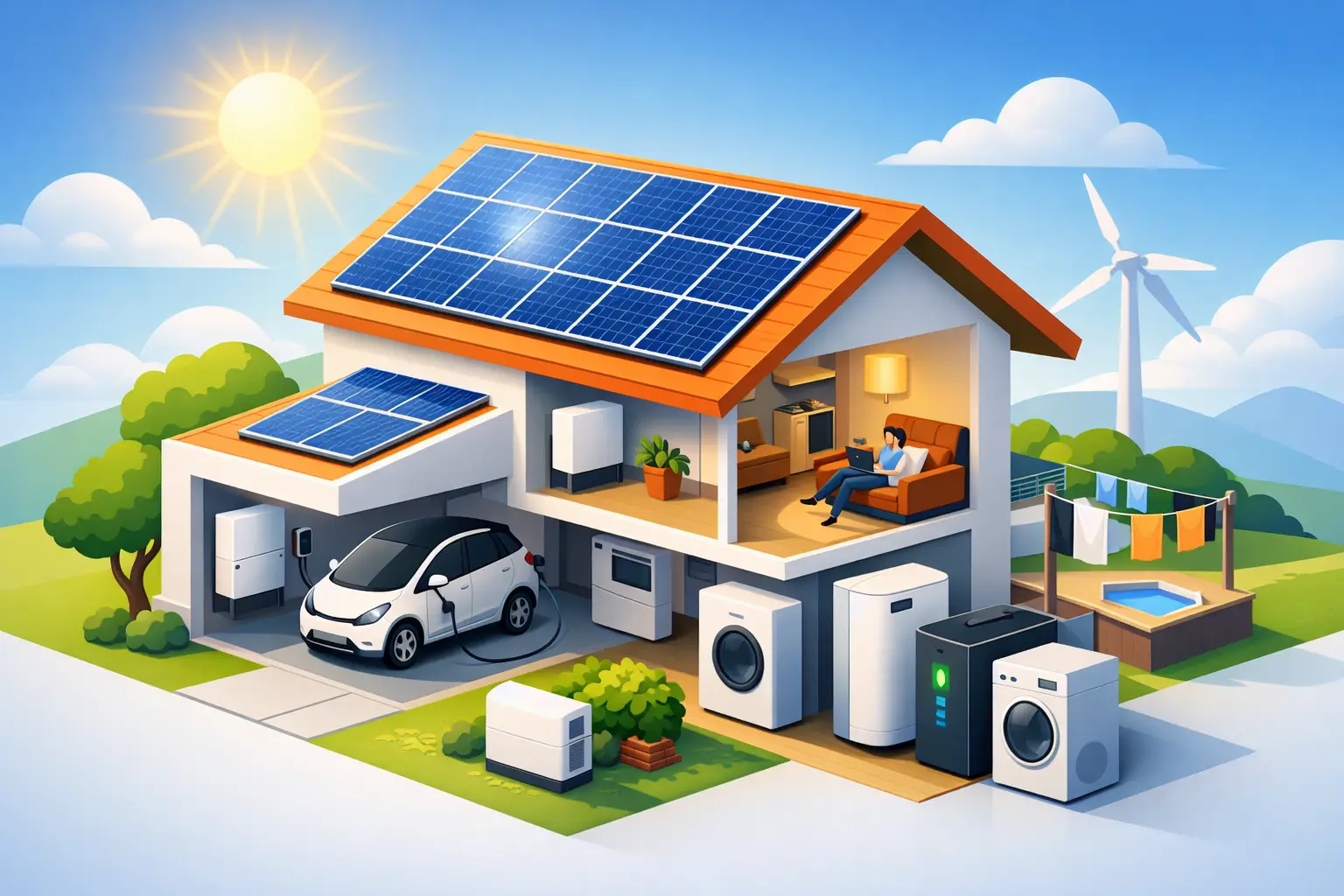
Your solar panels may produce their strongest output at midday, just as the house is at its quietest. Then, when the kettle, oven, heating or EV charger comes on in the evening, you may be buying electricity from the grid again. To optimise solar self consumption, the aim is simple: use more of the electricity your system generates on site, at the time it is produced or stored.
For UK households and businesses, this can make a meaningful difference to running costs. Export payments can still be useful, but the value of a unit of electricity avoided from the grid is often greater than the value received for exporting that same unit. The right approach depends on your property, routine, electricity tariff and future plans, but the principles are practical.
What solar self-consumption means
Solar self-consumption is the proportion of your solar generation that is used by your home or business rather than exported to the grid. If your panels generate 20kWh in a day and you use 12kWh directly or from a battery, your self-consumption is 60%.
This is different from solar self-sufficiency. Self-sufficiency measures how much of your total electricity demand is met by solar generation. A property can have high self-consumption while still importing a considerable amount of power in winter, when solar generation is lower. Both figures matter, but self-consumption is particularly useful when assessing whether your solar energy is being put to work effectively.
Without a battery, many households use around 30% to 50% of their solar generation directly. With well-sized battery storage, smart controls and considered energy use, that figure can increase significantly. It will not reach 100% every day, nor should that be the only objective. Oversizing equipment purely to chase a percentage can reduce the financial return.
Start with the way you use electricity
The cheapest way to improve solar self-consumption is often to move flexible electricity use into daylight hours. Before adding equipment, look at when your property consumes electricity and compare it with your solar production curve.
Appliances such as washing machines, dishwashers and tumble dryers can often be scheduled to run late morning or early afternoon. This is especially effective from spring to autumn, when PV output is more consistent. Use delay-start functions where available, but do not leave appliances running unattended if the manufacturer's safety guidance advises against it.
For homeowners working remotely, charging laptops, preparing meals earlier and using electric heating controls sensibly can also shift more demand into solar-producing hours. Small changes will not transform every system, but they can reduce unnecessary exports over a year.
Businesses may have an even better opportunity because daytime operating hours can naturally align with solar generation. Offices, workshops, farms and retail premises can benefit from reviewing refrigeration, ventilation, machinery, hot water production and vehicle charging schedules. The key is to identify loads that can move without disrupting the operation.
Measure before making changes
Monitoring gives the useful detail that a generation meter alone cannot. A good solar monitoring platform should show generation, household consumption, battery charging and discharging, and grid import or export in near real time.
Look at a few typical weeks rather than one exceptionally sunny day. Are you exporting heavily at noon while importing every evening? Is the battery full by midday but the property continues to export? Are particular appliances creating sharp imports after sunset? These patterns help determine whether a behavioural change, a control setting or additional storage is likely to offer the best result.
Use battery storage to retain surplus generation
Battery storage is one of the most effective ways to optimise solar self consumption. Instead of sending surplus generation to the grid in the afternoon, a battery stores it for use later when solar output falls and household demand rises.
A battery can be particularly valuable for homes where occupants are out during the day, as well as businesses with energy use outside solar-producing hours. It can also provide greater resilience when paired with suitable backup arrangements, although not every battery installation supplies power during a grid outage. This should be specified at the design stage if backup capability is important.
Battery size needs careful consideration. A battery that is too small may fill early and leave surplus solar to export. One that is too large may rarely fill from solar during darker months, increasing the time needed to recover its cost. The best capacity is based on your generation, overnight and evening demand, tariff, export rate and plans for an electric vehicle or heat pump.
It is also worth considering battery charge and discharge settings. Some systems can charge cheaply from the grid overnight on a time-of-use tariff, then support the property during higher-priced periods. This can reduce bills, but settings should preserve enough capacity to capture expected solar generation the following day. Automated tariff-aware controls can help, although they still need to be configured around the household's priorities.
Add smart control for larger electrical loads
Once the obvious appliance timings are covered, smart controls can direct surplus solar to larger loads. This is where self-consumption improvements can become more substantial.
An immersion diverter, for example, can send excess generation to an electric immersion heater to produce hot water. This can work well where a property has a hot water cylinder and regular hot water demand. It may be less suitable where the cylinder is already heated efficiently by another system or where hot water use is low.
EV charging is another major opportunity. A smart charger can be set to charge from solar surplus, rather than drawing a fixed amount of power from the grid. This is ideal when a vehicle is at home during the day. If the car is normally away, off-peak overnight charging may be the more practical and cost-effective choice. Many households use a combination: solar-led charging at weekends or on home-working days, and tariff-led charging when a full charge is needed by morning.
Heat pumps and electric heating can also be integrated into a wider energy strategy, but they require a more detailed assessment. Using solar power for heating sounds straightforward, yet space heating demand is usually highest in winter when solar output is lowest. Good controls, insulation and an appropriate tariff are just as important as solar generation.
Design the system around the property, not a headline figure
The performance of a solar installation begins with sound design. Panel orientation, roof pitch, shading, array size, inverter capacity and your expected electricity use all influence how much generation can be used on site.
South-facing panels usually deliver the highest annual output, but east-west arrays can be excellent for self-consumption because they generate over a broader part of the day. Morning and late-afternoon production may match household demand better than a sharper midday peak. This is one example of why the highest generation estimate is not always the only measure of value.
Shading deserves close attention. A chimney, neighbouring tree or roof feature can affect output disproportionately, particularly when modules are connected in the same string. Suitable system design, including optimisers where justified, can reduce the impact. However, optimisers are not automatically necessary on every roof, and a professional survey should establish whether they offer a worthwhile benefit.
For new installations, it is sensible to think ahead. If you expect to buy an EV, add a heat pump, build an extension or change the way you use the property, include that in the design conversation. It may be more cost-effective to allow for future battery capacity, a charger or additional panels from the outset.
Maintain performance and review your tariff
Solar PV requires relatively little maintenance, but it should not be ignored. Monitoring can highlight a fault, inverter issue or unexpected reduction in output. Periodic checks of the installation and electrical components help keep the system safe and performing as intended.
Your electricity tariff also has a direct effect on the value of self-consumption. Compare import rates, off-peak periods and export payments, then review them when your circumstances change. A tariff that suits a solar-only property may not be the best fit once battery storage or EV charging is introduced.
For properties in Lincolnshire, Norfolk, Cambridgeshire, Rutland and Leicestershire, a tailored assessment can turn broad advice into a system that reflects the roof, usage pattern and future energy needs. RJ Hill Electrical combines solar PV, battery storage, EV charging and electrical expertise to help customers make practical decisions rather than rely on assumptions.
The most effective next step is to review a month of generation and consumption data, then identify the hours when solar is exported and grid power is imported. That simple picture will show where smarter timing, storage or system upgrades can deliver the clearest savings.