How to Prepare for an EV Charger at Home
1 September 2026 | By RJ Hill Electrical
The best EV charger is one that fits how you actually use your vehicle, your property and your electricity supply. Knowing how to prepare for an EV charger before choosing a unit avoids costly alterations later and helps you charge safely, reliably and at the lowest practical cost.
A home charge point can make electric motoring far more convenient than relying on public chargers. But the charger itself is only one part of the job. Parking position, cable routes, earthing, available electrical capacity and future plans for solar or battery storage all need to work together.
Start with where your vehicle will park
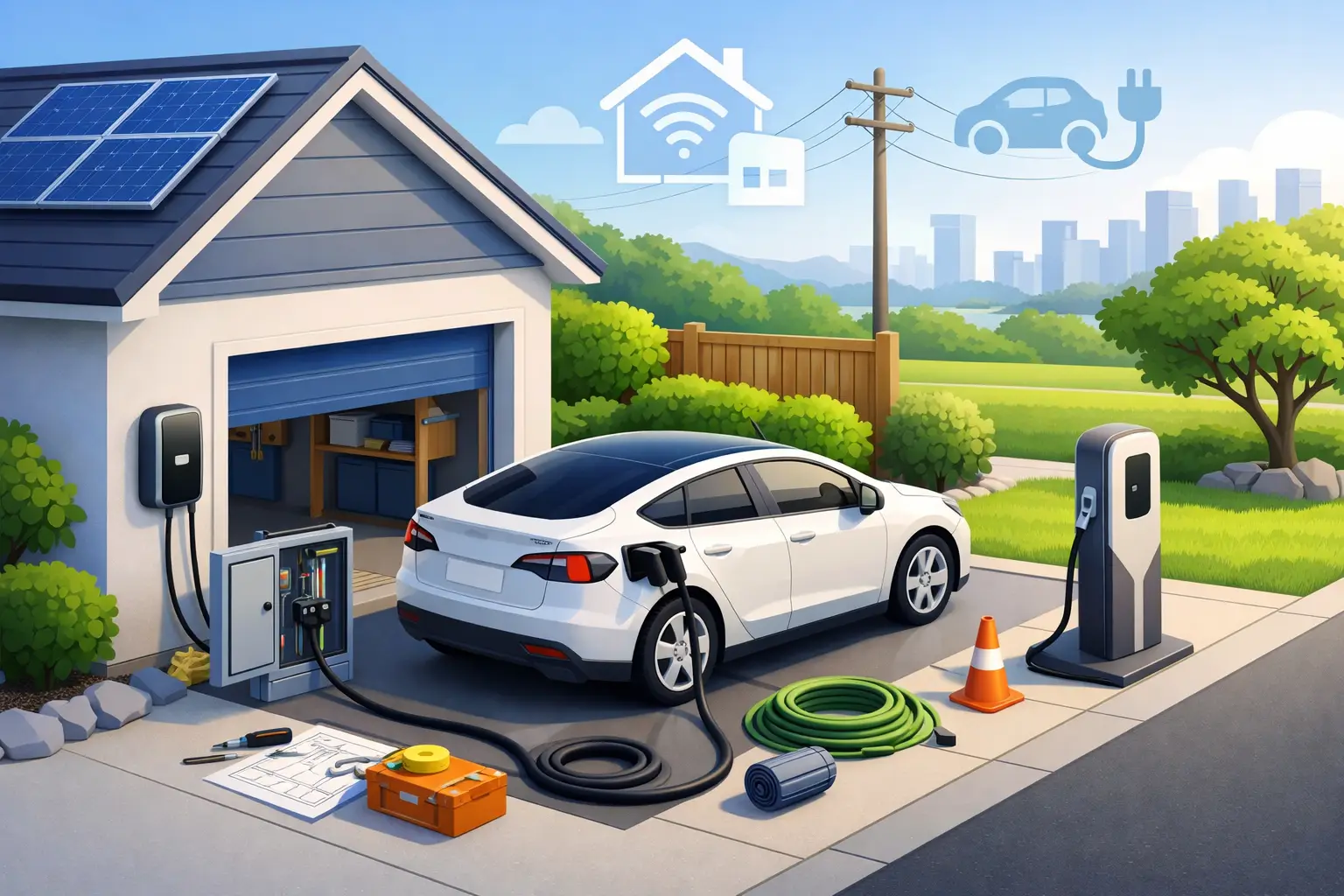
Your usual parking space should lead the decision. A charger needs to be close enough for the supplied cable to reach the vehicle comfortably, without being stretched across a pavement, driveway entrance or access route. The ideal location is normally on an external wall beside the drive, or on a purpose-built post where wall mounting is not practical.
Think about more than where the car sits today. If you may change vehicles, add a second EV or alter the layout of your drive, leave room for a second charging point or a cable route that can be extended later. For properties with a garage, charging inside can be practical, but only if there is sufficient ventilation, safe cable management and a route back to the consumer unit.
If you park on the street with no off-road space, domestic charging becomes more complicated. Charging leads must not create a trip hazard or cross a public footway without the appropriate solution and permissions. A site assessment can establish what is realistic before you spend money on equipment.
Check your electrical supply before selecting a charger
Most UK homes can accommodate a 7 kW single-phase charge point, but this should never be assumed. Your property may already have high electrical demand from an electric shower, induction hob, heat pump, immersion heater or workshop equipment. Adding EV charging without considering these loads can put unnecessary pressure on the installation.
A qualified installer will assess the incoming supply, the main fuse rating, meter position, consumer unit condition and spare capacity. They will also check the earthing arrangement and ensure the proposed installation complies with current BS 7671 wiring requirements. Where necessary, the Distribution Network Operator may need to be notified or consulted, which is normally managed as part of a professional installation process.
Charger power: faster is not always better
A 7 kW charger is often the right choice for a home with off-street parking. It can add a useful amount of range overnight and suits most daily driving patterns. However, it is not automatically the best option for every property.
A lower-power charger may be appropriate where supply capacity is limited or where the vehicle is parked for long periods. Three-phase charging can provide more power, but only where a three-phase supply is available and the vehicle can accept it. Commercial premises may have this supply already, while most homes do not.
Load balancing is particularly valuable in properties with significant electrical demand. This technology monitors overall consumption and reduces charging output temporarily when other demand is high. It helps avoid overloading the supply without asking you to manage charging manually.
Plan the cable route and consumer unit work
The neatest route is not always the safest or most economical route. A charger may look close to the consumer unit on a plan, but floors, external walls, garages, loft spaces and finished surfaces can make the cable run longer or more involved than expected.
Before installation, consider where cabling can be concealed or protected. External cable containment may be needed along a wall, while a detached garage may require an underground armoured cable. If the consumer unit is older, full or not suitable for the required protective devices, upgrades may be needed before the charger can be connected.
This is where experience matters. A properly designed installation should be safe, tidy and serviceable, rather than simply taking the quickest visible route across the property.
Choose a smart charger around your routine
Modern charge points are designed to charge intelligently, not just quickly. A smart charger lets you schedule charging for overnight periods or lower-cost electricity windows, helping to reduce the running cost of your EV. The benefit depends on your energy tariff, annual mileage and how consistently you can charge at home.
Choose a charger with controls you will genuinely use. App scheduling is helpful for many households, but clear local controls and reliable connectivity matter too. Consider whether the unit has a tethered lead, which is convenient for everyday use, or a socketed outlet, which can look tidier and offers flexibility between vehicles.
The right answer also depends on who will use it. A family sharing one EV may prioritise convenience and a longer tethered cable. A landlord may need access control and clear electricity-use records. A small business may need multiple users to charge fairly, with reporting for company vehicles or employee charging.
Prepare for solar and battery storage
If you have solar panels, or plan to install them later, tell your charger installer from the outset. The charger can be designed to work alongside solar generation and battery storage rather than being treated as a separate addition.
Solar-aware charging can direct surplus generation into the vehicle when conditions allow. This can reduce the amount of electricity imported from the grid, although it will not always provide a full charge at the speed you want. On cloudy days, during winter or when the vehicle needs to be ready quickly, grid electricity will still play a role.
Battery storage adds another consideration. It can help shift energy use and improve resilience, but charging an EV from a battery is not always the cheapest or most efficient approach. System settings should reflect your priorities: lower bills, using more solar power, protecting backup capacity or ensuring the car is charged by morning.
At RJ Hill Electrical, integrated electrical and renewable energy design helps customers avoid separate systems that compete for the same supply capacity. Planning the charger alongside Solar PV and storage can make a future upgrade more straightforward and better value.
Businesses and landlords should plan for growth
For commercial sites, an EV charger is rarely a one-vehicle decision. Even if you only need one or two charge points now, it is worth assessing parking demand, staff travel patterns, fleet plans and visitor use over the next few years.
Installing the required cable routes, containment and electrical capacity during the first phase can reduce disruption when more chargers are added. Load management is often essential where several vehicles may charge at once, particularly if the premises also have machinery, refrigeration, air conditioning or other heavy loads.
Landlords should also consider who pays for electricity, how access will be controlled and whether future tenants can use the equipment. A charger is an asset to a property, but only when its operation is clear and the installation has been designed for its intended users.
What to have ready for an installation survey
A survey is the point at which assumptions become a workable design. To make it productive, have the following information available:
- Photos of the proposed parking area, consumer unit, electricity meter and any garage or outbuilding involved.
- The make and model of your EV, or the vehicle you expect to buy.
- Details of high-demand electrical equipment, Solar PV, battery storage or planned renovations.
- Your preferred charger position and any concerns about visible cables, access or security.
- Your electricity tariff and typical times the vehicle is parked at home.
An experienced installer can then recommend the appropriate charger rating, cable route, protection, load management and future-proofing options. They can also explain any additional work clearly before installation begins, rather than presenting unexpected costs on the day.
A well-prepared EV charging installation does more than put power beside your driveway. It gives you a dependable way to run your vehicle, make better use of lower-cost electricity and leave room for the energy improvements your home or business may need next.