How Off Grid Solar Works for Homes and Businesses
11 July 2026 | By RJ Hill Electrical
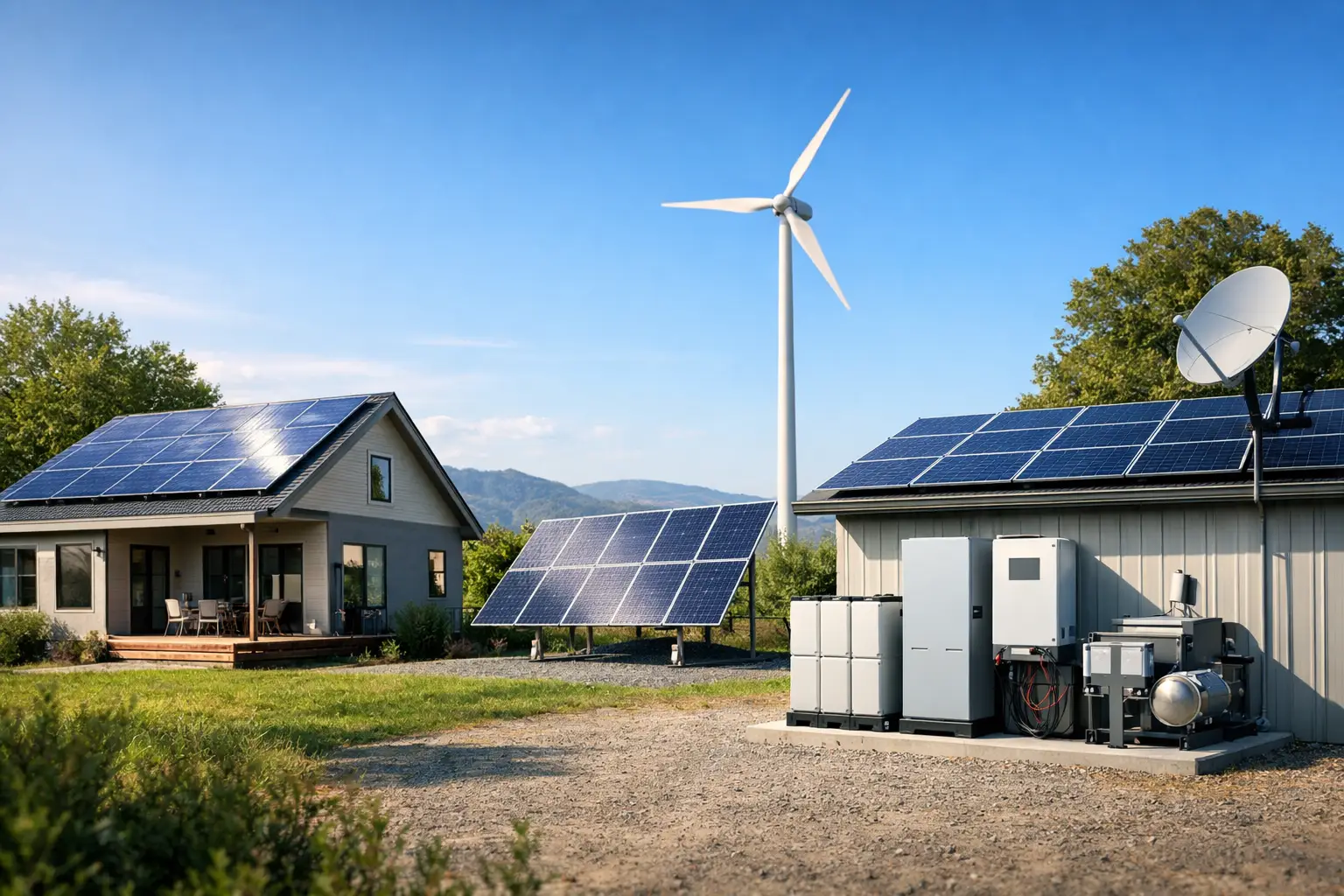
A property without a grid connection cannot simply rely on a few solar panels on the roof. It needs a carefully designed system that produces electricity, stores it for later and delivers reliable power when the weather changes. That is how off grid solar works: your own generation and storage system takes the place of the public electricity network.
For rural homes, outbuildings, farms, workshops and remote commercial sites, off-grid solar can offer genuine energy independence. It can also avoid the high cost and disruption of bringing a new grid connection to a site. The result depends on getting the system size right from the outset, particularly in the UK where winter solar production is much lower than summer output.
How off grid solar works day to day
Solar PV panels generate direct current, known as DC electricity, whenever daylight reaches them. The amount produced changes throughout the day and across the seasons. Bright summer days can create a substantial surplus, while short, overcast winter days may provide only a fraction of that output.
That electricity first passes through a solar charge controller or is managed by a hybrid inverter. Its job is to charge the battery safely and efficiently, protecting it from overcharging or being discharged too deeply. The battery stores the energy until it is needed.
An inverter then converts the battery's DC electricity into the 230V alternating current, or AC, used by normal sockets, lighting and most appliances. In practical terms, this means power can be used as it is generated during the day, with surplus energy held in the battery for the evening, overnight and periods of poor weather.
Unlike a grid-connected solar system, an off-grid installation does not export spare electricity to the network or draw electricity from it when production is low. The system must support its own demand. That makes design, battery capacity and sensible energy use central to performance.
The main parts of an off-grid solar system
Every installation is different, but a complete system is built around several connected components.
Solar panels
Panels are the generation source. Their required capacity is based on the property's electricity use, the available roof or ground area, panel orientation and expected seasonal production. A south-facing, unshaded array will generally produce more annual energy than a north-facing roof, but the right solution is always site-specific.
Battery storage
Batteries make solar power useful outside daylight hours. Modern lithium battery systems are popular because they are compact, efficient and designed for regular cycling. Battery capacity is measured in kilowatt-hours, or kWh. A larger battery can run more loads for longer, but it also increases project cost.
Battery sizing is not simply a case of choosing the biggest unit available. A system needs enough usable storage for expected evening and overnight demand, plus an appropriate reserve for poor weather. The best balance depends on whether the property is occupied full time, used at weekends or supports business-critical equipment.
Inverter and charge controls
The inverter is the control centre of the installation. It manages the flow of electricity between panels, batteries and property loads, while producing a stable supply for appliances. Its power rating also matters. A battery may hold plenty of energy, but the inverter must be capable of supplying high-demand loads such as pumps, kettles, ovens, power tools or refrigeration when they run.
Backup generation
For many year-round UK off-grid properties, a backup generator is a sensible part of the design. It can recharge batteries during extended low-sun periods or provide support when unusually high demand occurs. This is not a failure of solar. It is a practical way to maintain resilience without installing an excessively large and expensive solar array and battery bank purely for a few difficult winter weeks.
Some sites may also combine solar with wind generation, particularly where there is a genuinely exposed location and reliable wind resource. The value of this approach depends heavily on the site, planning requirements and local conditions.
What happens when you switch something on?
During daylight, solar generation normally supplies live demand first. If panels are producing enough electricity to run lighting, appliances or equipment, that power is used directly. Any surplus charges the battery.
Later in the day, when panel output falls below demand, the battery automatically takes over. The change is managed by the inverter and should not require the occupier to operate switches or manage separate circuits for ordinary use.
If the battery reaches its configured minimum state of charge, the system may start a backup generator automatically, depending on its design. Alternatively, it may reduce or disconnect non-essential loads to protect the battery. A well-designed system makes these priorities clear before installation, so essential equipment remains supported.
Designing for real electricity use
The most important question is not how many panels will fit on a roof. It is how much electricity the property uses, when it is used and which loads are essential.
A small cabin with LED lighting, a fridge, internet equipment and occasional tool use has very different requirements from a family home with an electric oven, borehole pump, immersion heater and electric vehicle. Heating is especially significant. Using electricity for space heating or hot water can increase system size dramatically, so alternatives such as a heat pump, wood burner, gas or other efficient heating arrangements need to be considered carefully.
A professional survey looks beyond total annual consumption. It considers daily kWh use, peak power demand, winter occupancy, roof condition, shading, cable runs, consumer unit capacity and future plans. If an EV charger, workshop machinery or additional accommodation may be added later, it is usually more cost-effective to account for this in the initial design.
Reducing unnecessary demand can lower the cost of the entire system. Efficient appliances, LED lighting, good insulation, sensible hot-water control and avoiding several high-load appliances running together all make off-grid living more practical. Energy independence works best when generation, storage and consumption are planned as one system.
Off-grid solar in a UK winter
Summer figures can be misleading. A system that appears generously sized in June may need careful management in December and January. Shorter days, low sun angles and cloud cover reduce solar generation just as lighting and heating demand often increase.
This does not mean off-grid solar is unsuitable for the UK. It means the design should be based on realistic seasonal data rather than peak summer output. In many cases, panels are sized to maximise winter production, with adequate battery storage and a generator contingency for prolonged dull weather.
It may also be necessary to adjust habits during the darkest months. High-consumption tasks can be scheduled for brighter periods, and battery state of charge should be monitored. Modern systems can provide this information through an app or local display, helping owners understand generation and usage without becoming energy engineers themselves.
Is off-grid solar right for your property?
Off-grid solar is often most attractive where a grid connection is unavailable, unreliable or prohibitively expensive. It can be a strong option for rural renovations, agricultural buildings, holiday accommodation, remote offices and properties seeking greater resilience.
For a home that already has a dependable grid supply, a grid-connected solar and battery system may be the more economical route to lower bills. It allows solar energy to be stored and used intelligently while retaining the network as a backup. Full off-grid operation carries greater responsibility because the system must meet demand through every season.
The right answer comes from a proper assessment rather than a standard package. At RJ Hill Electrical, we consider the property's electrical demand, site conditions, future requirements and the level of independence you want to achieve before recommending a solution.
A well-planned off-grid system can provide dependable power for many years, but it should be designed around your real life, not ideal weather. Start with an honest picture of what you need to run, then build a system that gives you the confidence to use it.