
How Home Battery Storage Works in UK Homes
16 July 2026 | By RJ Hill Electrical
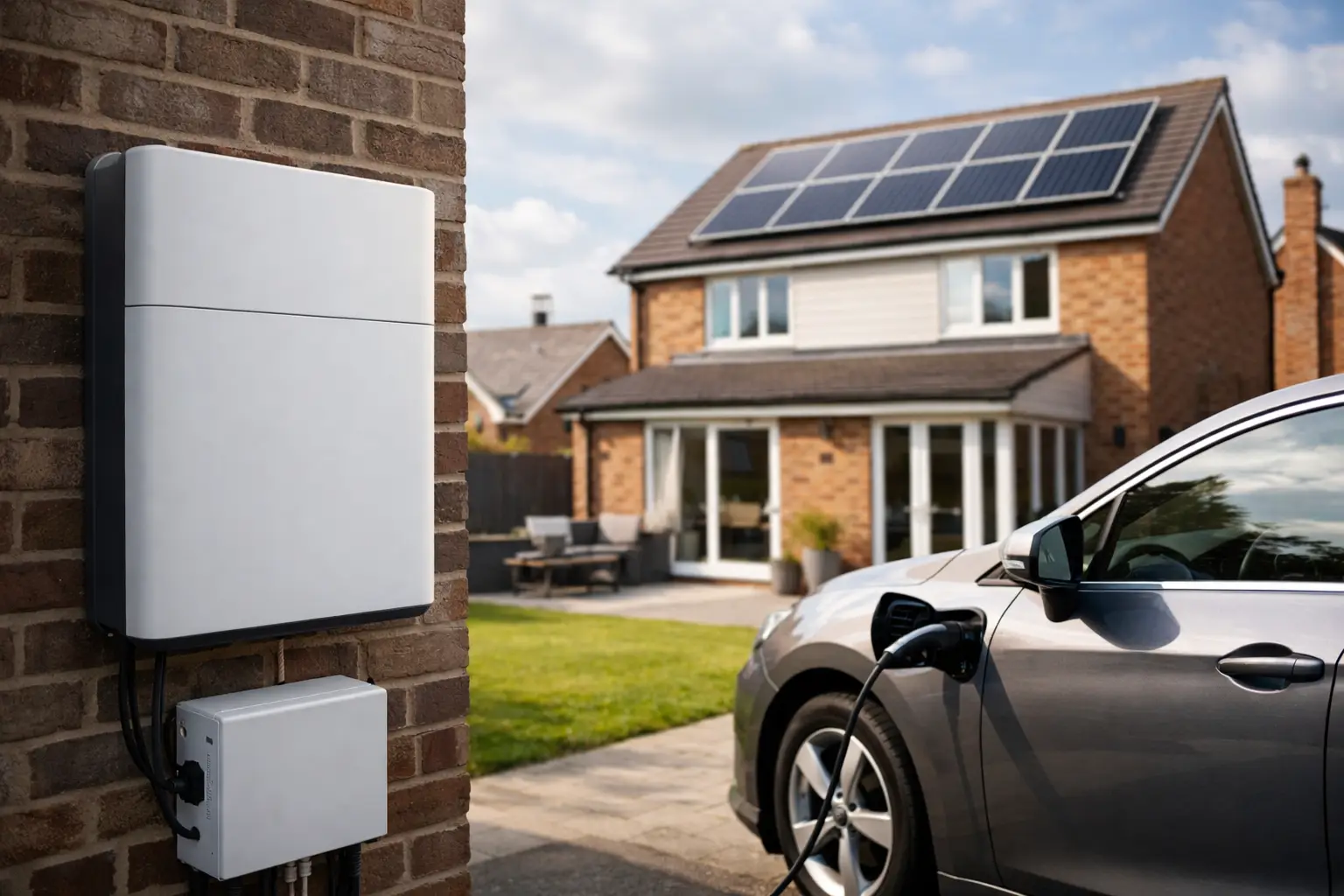
A home battery can make the electricity generated on your roof, or bought when prices are lower, available when your household actually needs it. Understanding how home battery storage works helps you decide whether it is a sensible next step for your home, alongside Solar PV or as a standalone energy upgrade.
For many UK households, the value is straightforward: use more of your own solar generation, buy less electricity at peak times and gain greater control over rising energy costs. The detail matters, though. Battery performance, savings and resilience depend on the system design, your energy use and the tariff you choose.
How home battery storage works day to day
A home battery stores electricity as direct current, known as DC power. This electricity can come from your solar panels, from the grid during lower-priced periods, or from a combination of both. When your home needs power, the battery releases that stored energy for appliances, lighting and other electrical loads.
Most homes use alternating current, or AC power, so an inverter is needed to convert electricity between the battery, solar panels, grid and property. In some systems, the solar inverter and battery inverter are separate. In others, a hybrid inverter manages both solar generation and storage in one unit. The right arrangement depends on whether a battery is being fitted with a new solar installation or added to an existing system.
The system continuously monitors what is happening at your property. If your solar panels are generating more electricity than the house is using, that surplus can charge the battery. When solar output drops later in the day, the battery can supply the home before electricity is imported from the grid.
A battery management system protects the battery cells and controls charging and discharging. It manages temperature, voltage and charge levels to support safe, efficient operation. You do not need to manage this manually. Once commissioned, the system is programmed around your priorities, such as maximising solar self-use, charging on an off-peak tariff, or retaining capacity for backup power.
The typical cycle with solar panels
Solar generation often peaks around the middle of the day, when many households are using comparatively little electricity. Without a battery, excess generation is exported to the grid. You may receive an export payment, but you will usually still need to buy electricity back during the evening when demand increases.
With battery storage, more of that daytime generation stays available for use at home. A typical cycle works like this: solar powers the property first, surplus charges the battery, and any remaining excess can be exported. In the evening, the battery discharges to cover household demand until it reaches its configured minimum charge level.
This can reduce grid imports significantly, particularly in spring, summer and early autumn. During winter, solar generation is lower, so a battery cannot create electricity that is not available. It can still be useful when paired with a suitable time-of-use tariff, charging at a lower overnight rate and supplying the property during higher-priced periods.
That is why battery storage should be viewed as part of an overall energy strategy rather than a single solution. Panel size, roof orientation, household consumption, heating type, EV charging and tariff structure all affect the likely outcome.
Charging from the grid can also reduce costs
Solar is not essential for a battery to work. A standalone battery can charge from the grid when electricity prices are lower and discharge when prices are higher. This is often called tariff shifting or energy arbitrage.
For example, a household on an off-peak overnight tariff may charge its battery in the early hours, then use that energy through breakfast time and into the daytime. The financial benefit depends on the gap between off-peak and peak electricity prices, the battery’s usable capacity, efficiency and the amount of electricity the household consumes at those times.
There are limits to consider. Every battery loses a small amount of energy during charging and discharging, known as round-trip efficiency. A well-designed system can still provide worthwhile savings, but it should not be sized or sold on unrealistic assumptions. Tariffs can also change, so the system needs to remain useful even if your energy supplier adjusts its rates.
Battery capacity and power are not the same
Two figures are particularly useful when comparing home batteries: capacity and power output.
Capacity is measured in kilowatt-hours, or kWh. It tells you how much energy the battery can store. A 10 kWh battery, for example, may have around 10 kWh of usable stored energy, although the exact usable amount varies by model and its operating settings.
Power output is measured in kilowatts, or kW. It tells you how quickly the battery can supply electricity. A larger capacity battery with a low power output may run for many hours at modest demand, but struggle to support several high-load appliances operating at once. Conversely, a high-power battery can respond well to heavier demand but may not have enough capacity to last as long.
The right balance is based on how your property uses electricity. A family home with evening cooking, laundry and an electric vehicle may have very different needs from a smaller household with lower daytime consumption. Businesses also need to consider their load profile, opening hours and whether equipment creates sharp peaks in demand.
Can a home battery provide backup power?
It can, but not every battery system provides backup power as standard. A normal grid-connected installation will usually shut down during a power cut as a safety measure. This protects network engineers who may be working on the electricity supply.
To keep selected circuits running during an outage, the system needs dedicated backup or emergency power capability. This may involve a backup gateway, changeover equipment and a separate consumer unit for essential circuits. The installer will help decide what those essential circuits should include, such as lighting, refrigeration, broadband, sockets and selected heating controls.
Running an entire property from a battery during an outage is possible in some cases, but it requires careful design. High-demand equipment such as electric showers, immersion heaters, ovens, heat pumps and rapid EV charging can drain a battery quickly or exceed its power output. Backup is most effective when it is designed around the loads that matter most.
What affects the savings from battery storage?
There is no single saving figure that applies to every home. The strongest returns usually come where a property has surplus solar generation, substantial evening electricity use, or access to a tariff with a meaningful off-peak rate.
A battery may be less effective if the household already uses most of its solar generation during the day, has very low electricity demand, or rarely uses power during expensive tariff periods. Export rates also matter. If you are paid well for exported solar electricity, it may sometimes be better to export rather than store it, depending on the cost of replacing that energy later.
System controls make a difference too. Intelligent monitoring can respond to generation forecasts, consumption patterns and tariff windows. However, automation is only as effective as the system configuration and the information it is given. A professional survey and clear discussion of your priorities are more valuable than simply choosing the largest battery available.
Choosing the right system for your property
A proper battery assessment begins with your electricity usage, not a product brochure. Half-hourly smart meter data, annual consumption, existing solar output and future plans all provide useful evidence. If you are considering an EV, electric heating, a heat pump or an extension, these changes should be included before the system is specified.
It is also worth considering where equipment will be installed. Batteries need a suitable location with adequate access, appropriate clearances and consideration for temperature. The inverter, isolators, consumer unit and cable routes must be designed to current electrical standards. Grid-connected installations may also require notification or approval through the local distribution network operator, depending on the system size and design.
For homeowners and businesses across Lincolnshire, Norfolk, Cambridgeshire, Rutland and Leicestershire, an integrated design can avoid costly compromises later. RJ Hill Electrical combines established electrical experience with Solar PV, battery storage and EV charging expertise, so the wider electrical system can be considered from the outset.
A home battery is most valuable when it is sized for the way you live, not for a headline capacity figure. Start with your bills, your current and future electricity use, and the level of energy independence you want. A tailored quotation can then show what a battery could realistically deliver for your property.