
Guide to Commercial Battery Storage for UK Firms
22 August 2026 | By RJ Hill Electrical
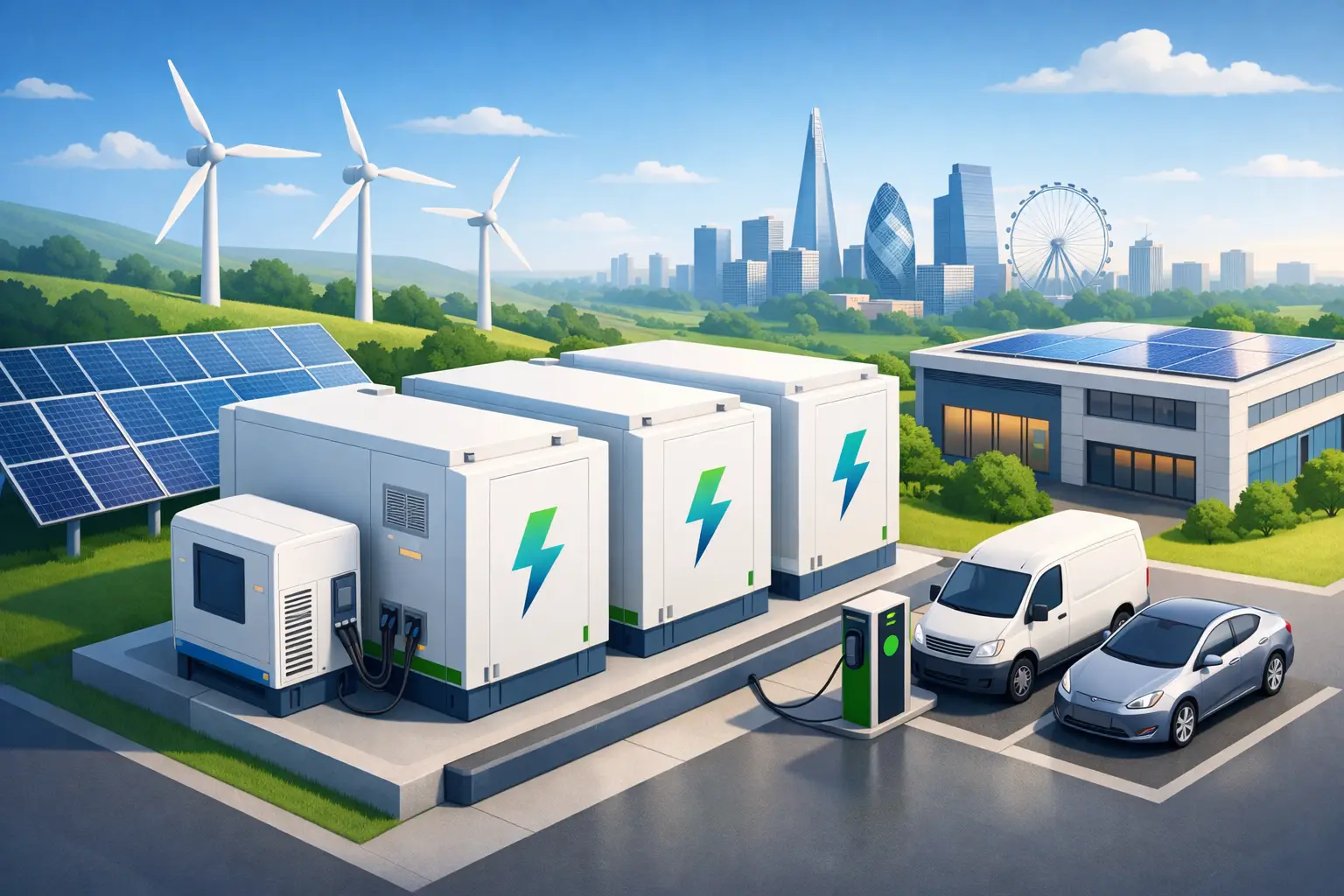
A business that buys electricity at peak daytime rates while exporting surplus solar power for a modest return is missing an opportunity. This guide to commercial battery storage explains how a well-designed system can retain lower-cost energy for use when it delivers the greatest value - helping to reduce bills, improve resilience and give your operation more control over energy use.
Commercial batteries are not simply larger versions of domestic units. The right design depends on your half-hourly consumption, tariff structure, site load, solar generation, operating hours and priorities during a power cut. For a warehouse, farm, office, workshop or retail premises, the best answer is rarely a standard package.
What commercial battery storage does
A commercial battery storage system stores electricity for later use. It may charge from on-site Solar PV when generation exceeds demand, from the grid when rates are lower, or from a combination of both. The stored energy can then supply the building when solar production falls, prices rise or site demand reaches a costly peak.
The practical benefit is better timing. Solar generation is often strongest around the middle of the day, whereas many businesses need more electricity in the early morning, late afternoon or evening. A battery shifts some of that solar value into those higher-demand periods rather than sending it straight back to the grid.
For sites without solar, battery storage can still be worthwhile where time-of-use tariffs create a meaningful difference between lower overnight rates and expensive peak periods. However, the financial case needs careful assessment. Charging a battery from the grid does not automatically produce savings once standing charges, tariff terms, battery losses and electricity price differences are considered.
When a battery is likely to make commercial sense
The strongest projects usually have a clear problem to solve. This could be high imported electricity costs, regular solar export, increasing EV charging demand, a high daytime load, or a need to keep selected equipment operating during interruptions.
A business with Solar PV and consistent evening consumption is a common example. Rather than buying grid electricity after the solar array stops generating, it can use power stored earlier in the day. Businesses with refrigeration, machinery, pumps, IT equipment or fleet charging may also benefit where batteries can reduce short periods of high demand.
Resilience can be equally valuable, but it should be defined precisely. A battery can provide backup power only if the system is designed with an appropriate backup or islanding arrangement. It will not necessarily keep an entire commercial site running as normal during a long outage. Most businesses identify essential circuits first, such as servers, lighting, alarms, refrigeration controls, communications equipment or critical production processes.
How to size commercial battery storage properly
Battery capacity is measured in kilowatt-hours (kWh), which tells you how much energy the system can store. Power is measured in kilowatts (kW), which tells you how quickly it can charge or discharge. Both matter.
A large-capacity battery with too little output power may not adequately support a site when several loads start at once. Equally, a high-power battery with limited usable capacity may discharge quickly and offer little value later in the day. The aim is to match the system to the shape of your demand, not simply buy the largest battery your budget allows.
A proper proposal should begin with energy data. Half-hourly electricity information, smart meter records and existing solar monitoring can show when the site imports, exports and experiences demand peaks. If your operation changes through the year, seasonal patterns need to be included. A farm, for example, may have very different loads during harvest, while a hospitality venue may see demand rise sharply over weekends and holidays.
Questions that shape the design
Before selecting equipment, establish how much electricity is used each day, when the highest loads occur, and how much solar energy is currently exported. It is also necessary to consider your current and future tariff, planned electric vehicles, heat pumps, machinery and any expansion of the premises.
Backup requirements need their own conversation. Which circuits are essential? How long should they operate? Are there motors or equipment with high starting currents? These details affect the inverter, distribution equipment and battery configuration as much as the battery capacity itself.
Battery storage, Solar PV and EV charging
Commercial battery storage produces its best results when it is treated as part of a wider electrical system. Solar PV reduces the amount of electricity you need to buy. Battery storage increases the proportion of that generation you can use on site. Smart EV charging can then make use of available solar or lower-cost off-peak electricity without creating avoidable demand spikes.
There are trade-offs. If the battery is reserved for evening loads, it may not have enough capacity to support rapid vehicle charging during the day. If resilience is the priority, part of the battery capacity may need to remain unused in case of an outage. The control settings should reflect the business objective rather than chasing a single headline figure for self-consumption.
For new installations, integrating Solar PV, batteries and charging infrastructure from the start can simplify the design and avoid duplicated electrical work. Existing solar systems can often be upgraded with an AC-coupled battery, although the most suitable route depends on the current inverter, network connection and site layout.
Costs, savings and payback expectations
Commercial battery storage costs vary considerably because no two sites have the same electrical requirements. Equipment is only one part of the investment. The quotation should also account for battery inverters, protection devices, cabling, distribution board alterations, metering, monitoring, commissioning and any backup arrangements.
Savings are influenced by the amount of solar energy diverted from export to on-site use, the difference between import and export prices, tariff opportunities, battery efficiency and the number of useful charge-discharge cycles achieved each year. A battery that sits largely full or empty because it has been poorly sized will not deliver the expected return.
It is sensible to review projected savings as a range, rather than accepting one fixed payback claim. Electricity prices change, businesses grow and operating patterns shift. A transparent design should explain the assumptions used, including forecast consumption, export value, tariff rates and usable battery capacity.
Installation standards and site considerations
A commercial battery is a significant electrical installation and should be designed by a competent contractor. The equipment location needs adequate space, safe access, suitable environmental conditions and consideration of fire safety guidance. Internal and external installations have different practical requirements, particularly where temperature exposure, security and cable routes are concerned.
Your installer should also assess the existing supply and distribution equipment. Some projects require upgrades to accommodate the additional generation, inverter capacity or backup board. Where grid connection limits apply, the system may need export control or approval through the relevant distribution network process.
Monitoring is not an optional extra. Clear generation, battery and import-export data allows you to check performance, identify changes in energy use and adjust charging behaviour over time. It also makes it easier to spot a fault before it becomes an expensive disruption.
Choosing the right commercial battery storage partner
The quality of the survey and design work is as important as the brand of battery. Look for an installer that asks for consumption data, explains system limitations, considers future loads and provides a clear scope of works. A good proposal should distinguish between bill reduction, solar self-use, peak management and backup power rather than presenting them as the same benefit.
For businesses across Lincolnshire, Norfolk, Cambridgeshire, Rutland and Leicestershire, RJ Hill Electrical can combine more than 20 years of electrical experience with Solar PV, battery and EV charging expertise. That integrated approach helps ensure the battery works with the rest of your site, not as an isolated addition.
The most valuable commercial battery is the one that reflects how your business actually uses power. Start with the data, be clear about the outcome you need, and invest in a system designed to keep delivering as your energy needs change.