EV Charger vs Three Pin: Which Suits Your Home?
21 August 2026 | By RJ Hill Electrical
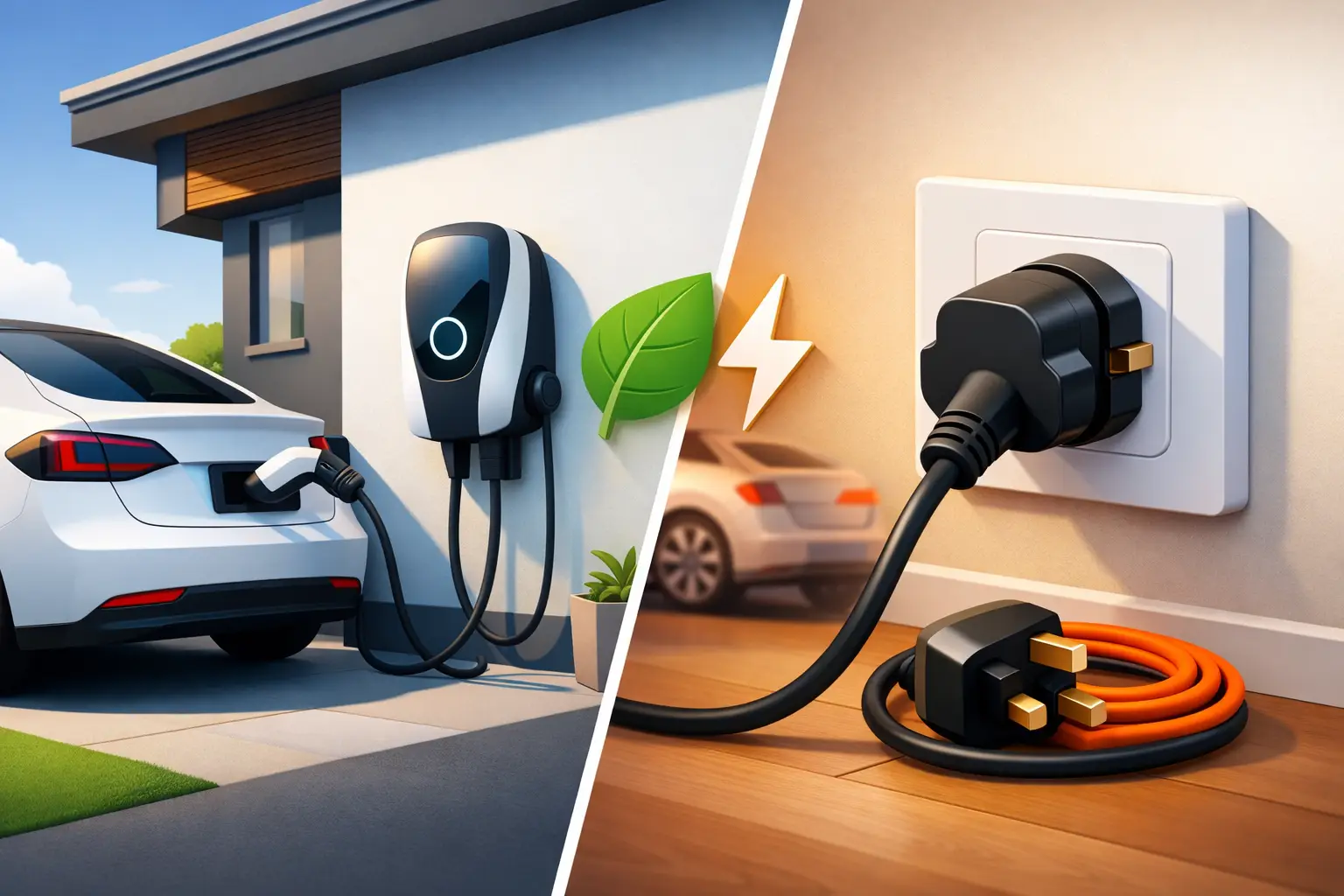
Your EV may have arrived with a three-pin charging cable, but that does not automatically make a standard socket the best long-term charging solution. In the EV charger vs three pin decision, the right choice comes down to how far you drive, how often you need to charge and whether you want a system that works with your wider energy plans.
For occasional top-ups, a three-pin lead can be useful. For regular home charging, a dedicated EV charger is normally quicker, safer and more convenient. It can also help you make better use of off-peak tariffs, solar generation and battery storage.
EV charger vs three pin: the practical difference
A three-pin charging cable, sometimes called a granny charger, plugs into a standard UK socket and typically charges at around 2.3kW. A dedicated home charger is installed on its own circuit and commonly provides up to 7kW on a single-phase domestic supply. In simple terms, a 7kW charger can deliver roughly three times the charging power of a three-pin cable.
That difference matters when a vehicle needs a meaningful recharge overnight. A 60kWh battery that is close to empty may take well over 24 hours on a three-pin cable, depending on the car and charging settings. On a 7kW charger, the same vehicle could often be charged overnight, with a typical full charge taking around eight to ten hours.
Charging speeds are never exact. Your car's onboard charger, battery size, starting state of charge and the power available at the property all affect the result. However, the gap between the two options remains significant for most households.
Three-pin charging: useful, but best kept occasional
Three-pin charging has an obvious advantage: no installation is required if you already have a suitable socket and the cable supplied with the vehicle. It is portable too, which can be helpful when visiting family, staying at a holiday property or dealing with an unexpected charging need.
The limitation is that a standard socket was not designed with daily, high-load EV charging as its primary purpose. Charging an electric vehicle can place a sustained load on the socket and circuit for many hours. Worn sockets, poor connections, unsuitable extension leads or older wiring can increase the risk of overheating.
A three-pin lead should be plugged directly into a properly maintained wall socket. It should not be used with an extension reel, multiway adaptor or damaged socket. If the plug, cable or socket feels hot, charging should stop and the installation should be checked by a qualified electrician.
Dedicated EV charging: built for the job
A dedicated charger is designed for regular vehicle charging. It is connected to a correctly sized, dedicated circuit and installed with the required protection devices. Modern units also provide built-in safety features, cable management and the option to lock or control charging through an app.
The biggest benefit is routine. You come home, plug in and know the car will be ready for the next journey. There is no need to plan a full day's charge around one domestic socket, or to run a cable through a window and across a path.
For households with one EV, a 7kW charger is usually the practical standard. For properties with multiple electric vehicles, a charger with load balancing can be particularly valuable. It monitors demand in the home and adjusts charging output to help avoid overloading the incoming supply.
Safety and installation considerations
The question is not simply whether a three-pin socket works. It is whether the electrical installation is suitable for repeated charging and whether it gives you the performance you need.
Before installing an EV charger, an electrician should assess the consumer unit, earthing arrangement, available supply capacity and cable route. The charger must be selected and installed in line with current wiring regulations. External chargers also need suitable equipment and positioning for the environment, including weather exposure and practical cable access.
A professional survey can identify issues before installation begins. In some homes, the work is straightforward. In others, upgrades to the consumer unit, cable route or supply arrangements may be needed. Addressing these properly protects the property and avoids compromising the charger installation for the sake of a quick fix.
Running costs: the electricity tariff matters most
A dedicated charger does not make electricity cheaper by itself. Your tariff and the amount of electricity used determine charging cost. What a smart charger can do is make it far easier to charge when electricity is cheaper.
Many EV tariffs offer lower overnight rates. A smart charger can schedule charging for those hours, so the vehicle takes electricity when rates are lower without you having to stay up or remember to plug in at a specific time. If the car needs to be ready by 7am, you can set a departure time and let the charger manage the schedule.
A three-pin cable may also allow timed charging through the car's own settings, but functionality varies by vehicle. It generally gives less visibility and control than a dedicated smart charger, particularly where household demand needs to be considered.
Using an EV charger with solar and battery storage
For homes investing in Solar PV, the choice becomes more strategic. A compatible smart EV charger can be configured to charge from surplus solar generation, reducing the amount of grid electricity used when conditions allow.
There is a trade-off. Charging solely from solar surplus may be slower and less predictable, especially through a UK winter or when the car needs a full charge for a longer trip. Many homeowners choose a mixed approach: use solar surplus when the vehicle is at home during the day, then schedule lower-cost grid charging overnight when needed.
Battery storage adds another layer of control, but it should be designed carefully. Using a home battery to charge a vehicle may be worthwhile in certain tariff or resilience plans, yet repeated high-power charging can deplete the battery quickly. An integrated system design looks at solar output, household consumption, battery capacity and driving patterns rather than treating each item as a separate purchase.
When a three-pin charger is enough
A three-pin cable can be suitable if you drive relatively few miles, have plenty of time between journeys and only need to add a modest amount of range. It can also work as a back-up cable for occasional use away from home.
For example, someone covering 15 to 20 miles a day may recover that energy overnight on a three-pin supply. The case is less convincing for a commuter travelling further, a family with irregular journeys, or a business that depends on vehicles being available every morning.
It is also worth considering future needs. A household that is buying its first EV today may add a second vehicle later, install solar panels, or switch to a time-of-use tariff. A well-planned charger installation gives more flexibility as those plans develop.
When a dedicated charger is the better investment
A home EV charger is usually the better option when charging will be a regular part of life. It offers faster recovery of range, a purpose-designed electrical connection and easier access to smart tariff and solar charging controls.
The upfront installation cost needs to be weighed against the convenience gained over years of ownership. For many drivers, avoiding public charging for routine journeys and charging at lower overnight rates makes the investment practical as well as convenient. It also presents a more considered solution for landlords, holiday lets and small businesses providing charging facilities.
RJ Hill Electrical designs and installs EV charging systems as part of wider electrical and renewable energy upgrades across Lincolnshire, Norfolk, Cambridgeshire, Rutland and Leicestershire. With more than 20 years of electrical experience, the focus is on a charger that suits the property, vehicle use and future energy goals.
If your EV is regularly spending all night on a three-pin lead, it is a good time to assess whether a dedicated charger would give you safer charging, better control and lower-cost electricity when you need it most.